Image

It’s a bright morning in November, and the cafeteria at Fayetteville Street Elementary buzzes as school leaders and community partners gather to celebrate the grand opening of the school’s new Family Resource Center.
“The room we’re going to see today was created by the community — our parents, our partners, our students and our staff,” says Principal Quincey Farmer. “A room for the people, made by the people, tailored to meet the real needs of our families. This is what community looks like. This is what collective care looks like.”
The center, Farmer explains, will be a place to empower families through resources, connections, learning opportunities or simply support when life gets hard.
Moments later, the ribbon is cut, and the crowd streams into a space designed not only to provide essentials but to embody the philosophy of community schools: schools as neighborhood hubs of support, empowerment and pride.
The center has a pantry stocked with free food, diapers and feminine products, and clothing. There are laptops for families to apply for jobs or enroll in benefits, a children’s corner for play and learning, and a meeting space.
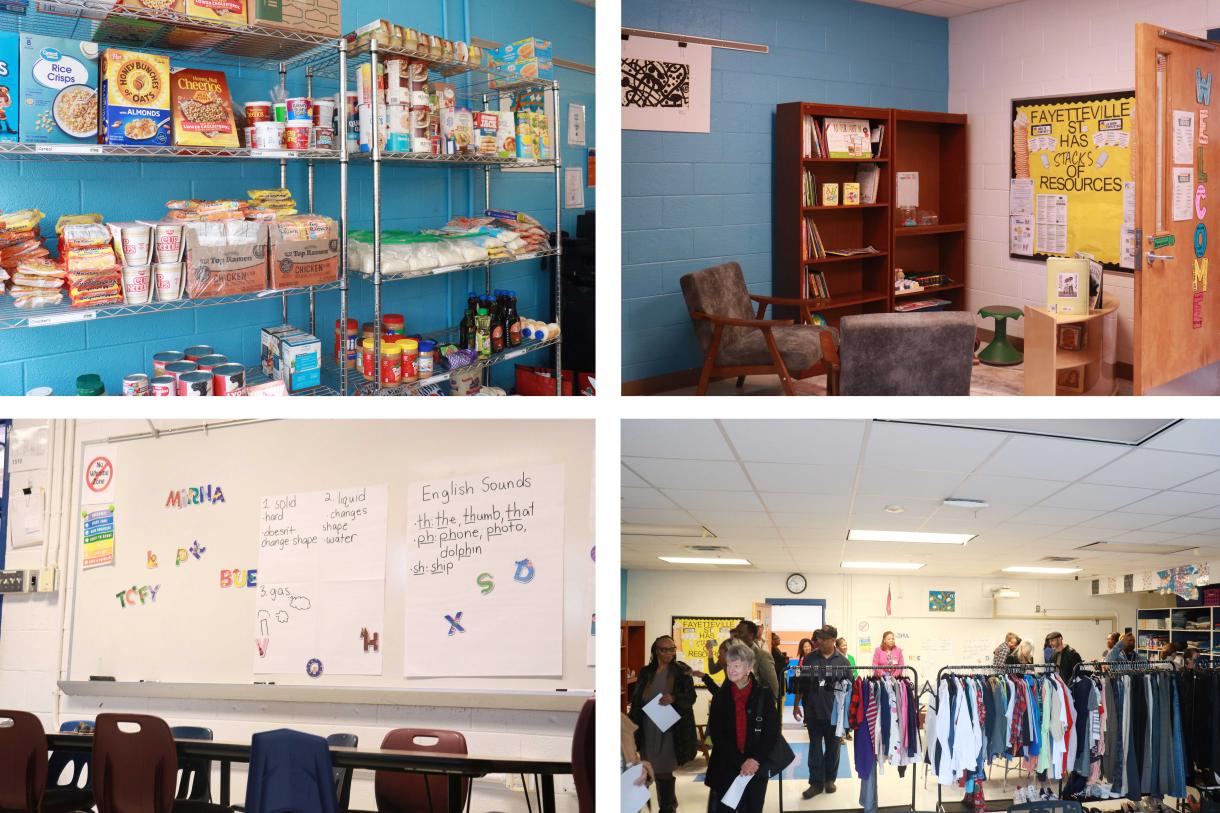
Community School Coordinator Chantal Cassells, who led the project, stands next to a full fridge and provides a bit of backstory: “We completed a needs and assets assessment last school year and families said they needed more support for hygiene, clothing and other resources. Right now, families are already lining up, ready to shop for those items.”
Cassells explains the center will be open throughout the day, welcoming families whenever they need it.
Her work goes far beyond this room, however, as she builds trust one family at a time. Recently, she met a mother in front of the school who had just immigrated from West Africa and wanted to enroll her child in kindergarten. The family faced barriers — from language to transportation — so Cassells stepped in and drove the mother to get her child’s immunizations and guided her through the steps to start school.
“That’s what this role and the center is about,” Cassells says. “Meeting families where they are and making sure they feel supported.”

Fayetteville Street Elementary became a community school in 2022 and is one of three in Durham — and 23 statewide — supported by the North Carolina Community Schools Coalition (NCCSC). For years, Duke has been a driving force behind the community schools movement, including through its Bass Connections project, University‑Assisted Community Schools, which brings together students and faculty from Duke, North Carolina Central University and Elizabeth City State University with local partners like NCCSC to expand and sustain community schools.
Alec Greenwald, a researcher with Duke’s Program in Education, and lead on the Bass Connections project, is one of the partners at the grand opening. “Community schools offer a more holistic approach to public schooling,” he says. “Over the last 15 years, the U.S. Department of Education has understood the impacts of community schools and invested nationwide in expanding Full‑Service Community Schools prioritizing rural and high‑poverty schools.”
In 2023, Duke Clinical Research Institute and partners secured a five-year federal grant to expand community schools across North Carolina. The grant helped create the NCCSC and continues to support its implementation of the North Carolina Community Schools Framework, with the goal of serving 23,000 students in 46 schools across 28 districts in 2026. The framework emphasizes the importance of full-time community school coordinators, like Cassells, and family resource centers.
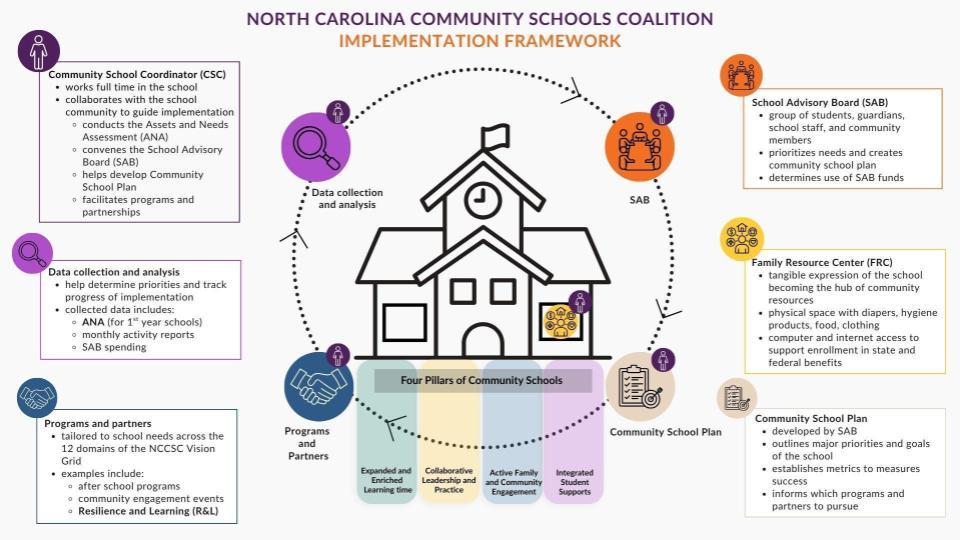
“These centers have been paramount for some of our western North Carolina schools during and after Hurricane Helene,” Greenwald notes. “Because families already knew they existed, when they needed resources, they knew where to go. Now, as families navigate new challenges like uncertainty around food assistance, these centers will be trusted spaces in their communities where they can go and access food.”
Going forward, Greenwald says it’s important to focus on how to sustain this work beyond federal funding. “We really need to consider how to blend and braid public and private dollars to scale community schools.” National evidence shows community schools improve attendance and math and literacy scores, and deliver a $7–$15 return for every dollar invested.
Each year, Bass Connections students work alongside faculty, staff and partners on three to five research questions generated by the NCCSC. More than 100 Duke students from diverse disciplines have contributed to the Bass Connections project, organizing professional development and creating tools statewide — such as quarterly teach-ins to learn about national implementation strategies and a Community Schools Capital dashboard for community school coordinators to foster partnerships.
Last spring, students produced a booklet of narratives of community school coordinators that is now used to onboard new coordinators across the state. This academic year, students developed state policy case studies that are informing the Public School Forum of North Carolina’s advocacy to state legislators. Students say the experience has shaped their future plans, inspiring one to pursue a teaching certificate and another to consider a career in educational policy.
Graduate student Alicia Davenport serves as a project mentor, guiding undergraduates in their research. This fall she was also part of a public policy class that worked closely with the Bass Connections project and NCCSC to design evaluation studies to strengthen family resource centers.

Following the grand opening, Davenport presents her team’s evaluation design to Cassells and partners. “We wanted to understand how family resource centers are equipped to respond during weather emergencies, and how lessons learned in one region could be applied statewide,” she explains.
Her work gives Cassells flexible guidance she can use as she oversees the Family Resource Center during emergencies and beyond. “Community school coordinators play a wonderful and enormous part in making community schools rock and roll,” Davenport said. “The family resource center’s function is central to that, and we want to ensure it’s supported during all kinds of challenges.”
The Family Resource Center at Fayetteville Street Elementary is a model of collective care and what can happen when communities and universities work together. As Principal Farmer says at the opening: “When our families are empowered, our students will win. We’ll see academic and social-emotional growth. Spaces like this create outcomes that ripple far beyond these walls.”
Those ripples are already visible. One mother recently shared that within a month of using the center, two teachers reached out to tell her they had seen a significant change in her children — more confidence, better attitudes and a stronger ability to stay focused throughout the day. “I know this is from the resource center because they have food, soap, deodorant, toothpaste,” she said. “It’s hard to learn and to grow on an empty stomach. It’s hard to feel confident and secure about yourself when you don’t have the things that you need.”
Listen to Bridging Campuses and Classrooms: University Partnerships That Power Community Schools with Alec Greenwald and Yolanda Dunston from North Carolina Central University.
Main image: Community School Coordinator Chantal Cassells welcomes partners and families into Fayetteville Elementary School’s new family resource center. The school’s principal and partners from Durham Public Schools, North Carolina Community Schools Coalition, Student U and Durham Public Schools Foundation stand beside and behind her. (Photo: Brandy Luce of Student U)