Image
Many Duke faculty have used small, strategic investments from the Provost’s Intellectual Community Planning Grants (ICPG) program to launch interdisciplinary collaborations that later attracted major external funding, created new academic programs and shaped public policy. Below are examples of how this seed funding enabled faculty to turn promising ideas into collaborative efforts with lasting impact.
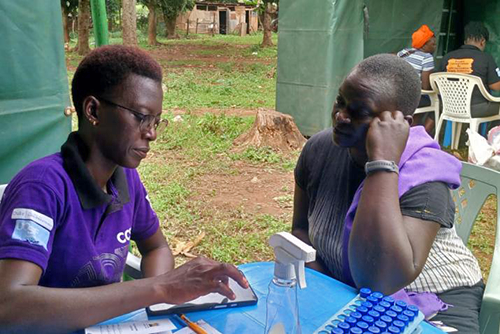
Seven out of ten cancer-related deaths are in low- and middle-income countries. For cervical cancer, that figure jumps to nearly nine out of ten.
In 2017, Duke scholars from medicine, engineering and the Duke Global Health Institute came together to explore how they could collectively address this global cancer disparity.
Many women may not be able to travel to a distant clinic for screening, the costs may be too high or they may feel shame or stigma.
“The ICPG helped us plan several projects, including three funded grants and Nimmi Ramanujam’s Bass Connections projects, and it shaped research opportunities for Ph.D., master’s and undergraduate students,” said Megan Huchko, the Hollier Family Associate Professor of Global Health.
Huchko, Ramanujam and their colleagues focused on designing cervical cancer prevention around women’s needs, including such innovations as the Pocket Colposcope and the mobile health app mSaada.
At Duke, scholarship on risk is aimed at improving society’s capacity to deal with major challenges such as climate change, pollution, pandemic disease and financial shocks. In 2018, Mark Borsuk, Jonathan Wiener and other faculty members received an ICPG to help position Duke as a leader in the field.
“The ICPG launched what became a durable, university-wide intellectual community around risk — one that grew directly into the Duke Center on Risk and ultimately seeded major grants, new academic programs and cross-campus collaborations,” said Borsuk, the James L. and Elizabeth M. Vincent Professor of Civil and Environmental Engineering.

Housed in Duke Science & Society, the center has fostered partnerships among faculty and students from eight schools.
In addition to securing major external research grants, the group developed new curricula and degree programs in risk and resilience and built a thriving scholarly and student community. Duke now has a sustained presence in national and global discussions on risk, resilience and climate governance.
As a one-acre working farm, the Duke Campus Farm provides sustainably-grown produce and food systems education for the university and its surrounding communities. Through the farm’s courses for credit, Duke students can explore topics such as “Regenerating Food Systems” and “Imagining the Future of Food.” Faculty can also integrate the farm into their teaching and research.

The farm’s director, Saskia Cornes, is also assistant professor of the practice at the John Hope Franklin Humanities Institute. She received an ICPG in 2022 to learn firsthand from other campus farms at four liberal arts institutions — Yale, Amherst, Hampshire and the University of Massachusetts. Through site visits, she paid particular attention to how the schools structure their farms to maximize interdisciplinary learning, integrate students into programmatic leadership and work with faculty to broaden their intellectual reach.
“I came back with new best practices and new inspiration for climate education,” Cornes said. “This grant reenergized the entire Duke Campus Farm team, my classrooms and the farm’s faculty stakeholders. It kickstarted an informal network that I’m still benefiting from years later, across our own campus and with peers across the country.”
If the current rate of pollution continues, plastic debris will outweigh all the fish in the oceans in just 25 years.
In 2023, a group received an ICPG to expand its activities on plastic pollution begun through a Catalyst grant, in order to develop and inform policy and management solutions. Zoie Diana, Meagan Dunphy-Daly, Nancy Lauer, Michelle Nowlin, Daniel Rittschof, Jason Somarelli and John Virdin included students, staff and other faculty in their vision.

Housed in the Nicholas Institute for Energy, Environment & Sustainability, the Plastic Pollution Working Group is composed of over 60 faculty, students, staff and postdocs from a wide range of disciplines, including environmental toxicology, business, medicine, public policy, engineering, law and many more. Bass Connections projects give students further opportunities to get involved.
Numerous doctoral students involved with the group have moved into the next phase of their careers. Zoie Diana, for example, will be an assistant professor at Columbia, and many others are on the leading edge of the plastic pollution field. Anna Lewis made her own PET fibers as part of her Ph.D., and Imari Walker-Franklin leads her own research lab on microplastics at RTI. Law student Dacie Meng works on plastic policies for the Ellen MacArthur Foundation, and M.E.M. student Anne Elizabeth Baker leads sustainability and plastics reduction initiatives at the N.C. Department of Natural and Cultural Resources.
Work from the group has led to funding from the NSF (Growing Research Convergence) and the Underwriters Laboratories Research Institute focused on the negative health impacts from plastic pollution. Over 30 publications have come out of the group, including a 2025 report on the social cost of plastic to the U.S.
Demand for lithium and other critical minerals is increasing, and only a few countries are producing and processing them. This limited availability threatens the stability of industries from energy and transportation to telecommunications and manufacturing.
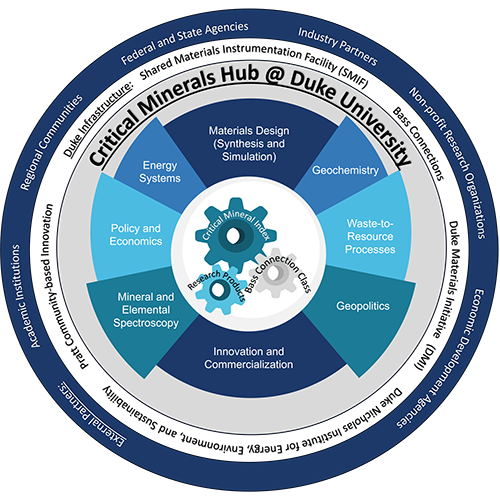
“The challenges are complex and interconnected,” said Leanne Gilbertson, associate professor of civil and environmental engineering. “Building a resilient critical mineral system demands a research culture that bridges schools and disciplines — and forges partnerships beyond academia.”
Gilbertson and other faculty received an ICPG in 2024 to strengthen Duke’s capacity to address this vital area. A symposium brought together scholars and students with industry and government stakeholders, and a follow-up session helped shape plans for capstone projects, internships and data-sharing.
In 2025, Duke’s provost selected the group for a Multiyear Interdisciplinary Hubs grant. Through the Critical Minerals Hub, experts from different fields are developing a framework for managing demand and supply in the short term and reducing critical minerals dependence over the long term.
Since its launch last July, the Critical Minerals Hub has created a Bass Connections project called Critical Minerals Nexus: Geosciences, Engineering and Policy and hosted two industry-focused networking events. Members have published six publications.
These examples illustrate how Intellectual Community Planning Grants help faculty move quickly from promising ideas to sustained, externally funded collaborations. Faculty who seek to explore new interdisciplinary collaborations or strengthen existing ones are encouraged to apply for the next round of ICPGs by March 20, 2026. Please see the RFP for details.
Main image: Duke Critical Minerals Hub researchers in September 2025